Accelerated biomass loss in western US forestlands due to shifting fire regime
Abstract
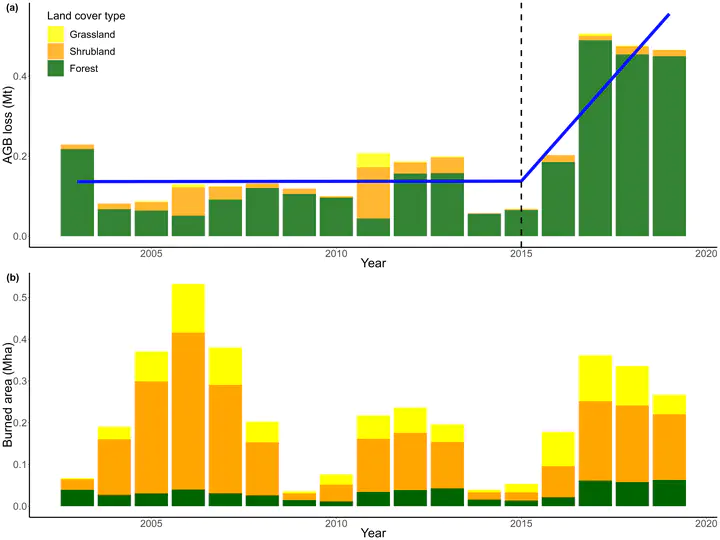
Wildfires influence the distribution of biomass across the Earth’s surface and drive carbon losses from the land surface to the atmosphere. Although the global budget between terrestrial and atmospheric carbon pools is comparatively well understood, the growing size and severity of wildfires present an increasing challenge to regional carbon accounting. In this study, we used remote sensing data to estimate aboveground live biomass density at 30-meter resolution across Utah and Nevada annually from 2000 to 2022. The results showed accelerated loss of terrestrial carbon to the atmosphere due to increasing wildfire, with annual biomass burned increasing at 0.105 ± 0.024 Mt yr⁻¹ after 2015. Recent shifts in the wildfire regime indicate a transition from predominantly early-season fires in low-biomass grasses and shrubs to late-season fires in higher-biomass forestlands. The proportion of total biomass loss attributed to forestland wildfires increased from 76% per year before 2015 to 94% after 2015. We further found that recent droughts contributed to increased biomass loss in forestland areas, whereas biomass in non-forestland areas appeared less affected by drought conditions. These findings highlight the escalating impact of climate change on fire regimes and the need for adaptive land management strategies to mitigate carbon loss and preserve ecosystem resilience under ongoing aridification.

Shike Zhang
SEAS PHD Student
My research interests include numerical simulation, ecological and environmental problems.